Teaching main idea can be tricky, especially when students can tell you what a passage is about but struggle to explain what the author wants them to understand about that topic.
When I taught main idea in my upper elementary classroom, I found that students needed more than a definition of main idea. They needed to see the thinking process modeled, learn how supporting details work together, and have plenty of opportunities to practice with manageable texts.
If you’re teaching main idea in 3rd, 4th, or 5th grade, these strategies can help your students move from simply naming the topic to identifying—and supporting—the main idea.

Why Is Main Idea Difficult for Students?
Main idea can be a challenging reading skill for upper elementary students. When I taught fourth grade, I often found that students could tell me the topic of a passage but had difficulty taking that next step and identifying the main idea.
Other students would latch onto an interesting detail from the passage and choose it as the main idea. And even when students understood the difference between a main idea and a supporting detail, they sometimes had trouble deciding which details were actually important.
That’s why I found it helpful to break main idea instruction into smaller steps. Instead of simply asking, “What is the main idea?” I wanted students to think about a few questions as they read:
- What is this text mostly about?
- What does the author want me to understand about that topic?
- Which details are most important?
- How do those details support or prove the main idea?
These questions help students move beyond simply finding something interesting in the text and begin thinking about how the important ideas and details work together.
I especially like that last sentence for your post because it sounds like teaching advice rather than SEO content, while naturally reinforcing main idea, details, and support.
And now I have what I need from you. I don’t need anything else before we begin writing.
My recommendation is that we work through the updated post in order, rather than my handing you a giant rewritten article all at once. That will let us make sure it continues to sound like you and gives us a chance to think carefully about photos, internal links, and the two soft sells as we reach them.
How to Teach Main Idea and Supporting Details
When teaching main idea, I like to break the skill into smaller steps rather than expecting students to identify the main idea right away. Helping students first recognize the topic, then think about what the author wants them to understand about that topic, gives them a much clearer path to finding the main idea.
From there, students can begin looking closely at the supporting details and asking an important question: How do these details help me know that this is the main idea?
Here are some strategies that can help students work through this process.
1. Start With the Topic
Before asking students to find the main idea, make sure they understand the difference between the topic and the main idea.
I like to keep the distinction simple:
The topic tells what the text is mostly about.
The main idea tells the most important thing the author wants you to understand about that topic.
For example, imagine students are reading a short passage about monarch butterflies traveling thousands of miles to warmer areas each fall.
The topic might simply be monarch butterflies or monarch migration.
The main idea would tell us something more: Monarch butterflies make a long migration to warmer areas each fall.
One question that can help students make this distinction is:
“What does the author want me to know about this topic?”
This encourages students to move beyond giving a one- or two-word answer and begin thinking about the author’s message.
You can also model this with short passages as a whole class. First, identify the topic together. Then ask students to finish a sentence such as:
“The author wants me to understand that ______.”
I found that breaking the process into these smaller steps helped students see that identifying the topic is important—but it is only the first step toward finding the main idea.
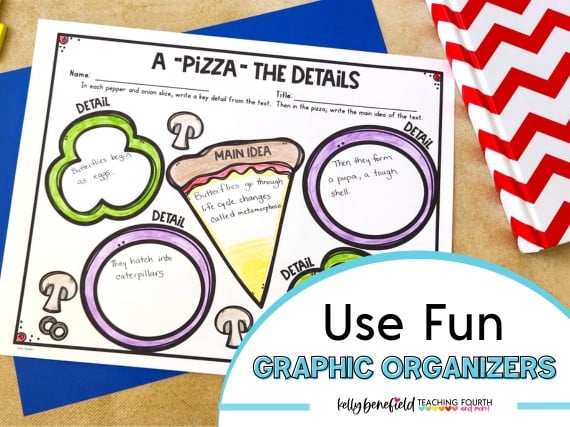
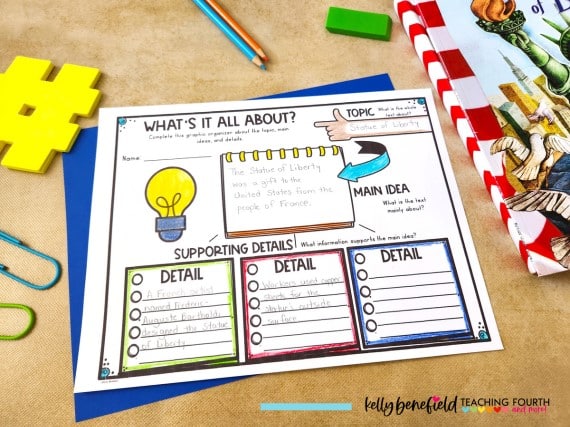
Unfortunately, we cannot see what our students are thinking when they read. Graphic organizers are a great way for students to make their thinking visible. This not only helps us understand what our readers are thinking, but it can also help our students form a visual representation of the relationship between the main idea and details. By seeing this information laid out in a structured format, students can better understand how the details contribute to the main idea. Having a visual representation can help students grasp abstract concepts more concretely.
Providing our students with a main idea graphic organizer gives them a framework for organizing their thoughts. As students complete the graphic organizer, they actively engage with the text. This organizational support helps students analyze the text and supports them as they search for the main idea and details.
2. Model How You Find Main Idea
Finding the main idea requires quite a bit of thinking, and sometimes we forget that our students can’t see all of the thinking that is happening in our heads as we read. One of the best ways to help students understand the process is to model your thinking out loud.
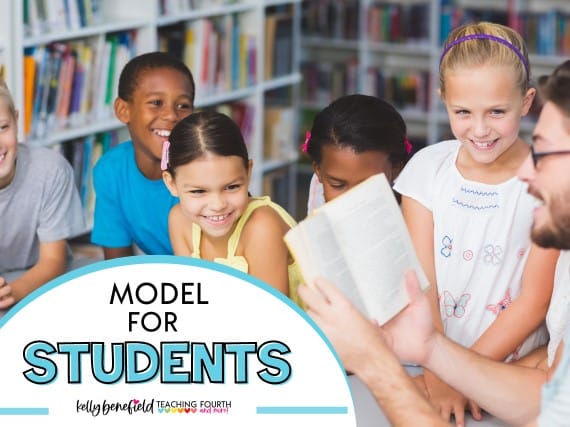
Choose a short passage and read it together. As you read, stop and talk through what you notice. You might say:
“I know this passage is about honeybees, so honeybees is my topic. But that isn’t enough to tell me the main idea. I need to think about what the author wants me to understand about honeybees.”
Then look more closely at the details:
“I’m noticing that several of these details are about how honeybees communicate. One detail tells me that bees use movements, another explains that their movements can show direction, and another tells how bees help others find food. These details all seem to connect.”
Finally, put those clues together:
“Since several important details are about the ways honeybees communicate, I think the main idea should include that information. The author wants me to understand that honeybees use special movements to communicate important information to other bees.”
As you model, remind students that they aren’t simply looking for a sentence that sounds important. They are thinking about the passage as a whole and looking for an idea that connects the most important details.
It can also help to model a wrong answer occasionally. Choose an interesting detail from the passage and ask, “Could this be the main idea?” Then think aloud about why it doesn’t work. If the other important details don’t support that idea, it probably isn’t the main idea.
This kind of modeling gives students a process they can begin using on their own:
Identify the topic → Notice the important details → Look for what connects them → State the main idea
With plenty of modeling and guided practice, students can begin to internalize these questions and use them independently as they read.
Modeling your thinking is also an important part of teaching other reading comprehension strategies in upper elementary.
3. Connect the Supporting Details to the Main Idea
Once students can identify the topic and begin thinking about the main idea, the next step is helping them recognize which details are actually important.
This was often a tricky part for my students. Sometimes they would choose a detail simply because it was interesting or easy to remember. I wanted them to understand that an interesting detail isn’t necessarily an important supporting detail.
One simple question can help:
“How does this detail support the main idea?”
As you read a passage together, have students identify several details and discuss how each one connects to the main idea. If a detail helps explain, describe, or give evidence for the main idea, it is probably an important supporting detail. If it doesn’t really help us understand the main idea, it may not be one of the most important details in the passage.
You can even turn this into a quick whole-class activity. Write the main idea at the top of the board and list several details from the passage underneath it. Take each detail one at a time and ask students, “Does this help prove our main idea? How?”
I especially like adding that second question. Students shouldn’t just decide yes or no. Asking them to explain how a detail supports the main idea encourages them to go back to the text and think more carefully about the connection.
With practice, students begin to see that the main idea and supporting details aren’t separate pieces of a passage. The important details work together to help readers understand—and prove—the main idea.
4. Make Students’ Thinking Visible With Graphic Organizers
When students are reading, we can’t always see the thinking that is happening in their heads. Graphic organizers can help make that thinking visible and give students a place to organize what they are learning about the main idea and supporting details.
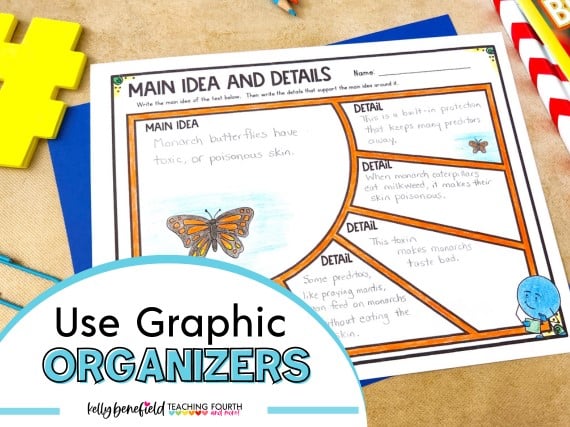
I especially like using graphic organizers after we have modeled the skill together. Students can record the topic, determine the main idea, and then add the important details that support it. Having all of the information in one place makes it easier for students to see how those pieces fit together.
Graphic organizers can also be helpful because not every student needs the same amount of support. Some students may need an organizer that clearly separates the main idea from three supporting details. Others may be ready for an organizer that requires them to do a little more of the thinking and organizing on their own.
There are many different types of graphic organizers for reading, so you can choose a format that fits both the skill you are teaching and the needs of your students.
I also like that you don’t need a special passage to use them. Students can practice finding the main idea with a nonfiction picture book, textbook selection, article, reading passage, or other nonfiction text you are already using in your classroom.
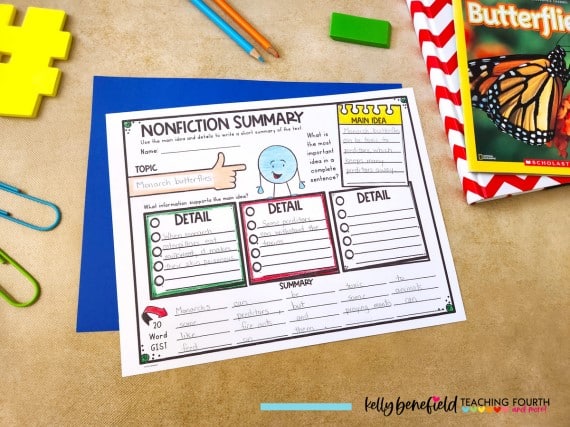
If you would like several options to choose from, my Nonfiction Reading Comprehension Graphic Organizers include a variety of organizers for practicing main idea and supporting details, along with many other nonfiction reading skills. This makes it easy to choose an organizer that works well with the text you are reading and the needs of your students.
[Take a closer look at the Nonfiction Reading Comprehension Graphic Organizers.]
5. Begin With Short, Clear Texts
When students are first learning to identify the main idea, keep the text simple and manageable. This gives students a chance to focus on the skill without getting overwhelmed by a long or complicated passage.
I like to begin with short texts that have a fairly clear main idea and supporting details. At this stage, the goal isn’t to trick students or give them several answers that might work. We want them to become comfortable with the thinking process and experience success using it.
Add some fun to your lesson with a fun graphic organizer. I realize graphic organizers has already been mentions as one of the tips for teaching main idea, but here is an added tip: don’t just choose basic graphic organizers. Instead, choose engaging and fun graphic organizers that your students will love!
As students read, continue using the questions you’ve already practiced together:
What is the topic?
What does the author want me to understand about the topic?
Which details are most important?
How do those details support the main idea?
Once students become more confident, you can gradually increase the difficulty. Try passages in which the main idea isn’t stated as clearly, texts with details that are interesting but not essential, or passages that require students to think across several paragraphs to determine the overall main idea.
This gradual progression is especially helpful for students who struggle with main idea. Instead of giving them an easier skill, you’re giving them a more accessible place to begin practicing the same skill.
As their confidence grows, you can remove some of the support and challenge students with increasingly complex texts. The goal is for students to eventually use these same strategies independently—whether they’re reading a short passage, an article, a textbook selection, or a nonfiction book.
Starting simple and gradually increasing the challenge gives students time to develop the thinking process they need before we ask them to tackle more difficult texts on their own.
6. Teach Students to Prove the Main Idea
Once students can identify a possible main idea, I don’t want them to stop there. I want them to be able to go back to the text and prove their thinking.
A simple way to encourage this is to follow “What is the main idea?” with another question:
“What in the text proves that?”

Students can return to the passage and find two or three important details that support their answer. This helps prevent them from choosing a main idea simply because it sounds right or because it includes an interesting detail they remember.
You can model this during whole-group instruction by stating a possible main idea and then going back through the passage together. Ask students to point out the details that provide the strongest evidence. You might underline, highlight, or list those details and discuss why each one supports the main idea.
I also like turning the question around occasionally. Give students a possible main idea and ask:
“Can we prove this with the text?”
If students can’t find enough important details to support it, that is a good clue that they may need to rethink their answer.
This small shift from simply finding the main idea to proving the main idea encourages students to read more carefully and think about how the ideas in a text work together. It also reinforces an important reading habit that carries over into many other comprehension skills: when we make a claim about a text, we should be able to support it with evidence from what we read.
7. Give Students Plenty of Independent Main Idea Practice
After you’ve modeled the process and practiced together, students need plenty of opportunities to apply the skill on their own. Short passages work especially well for this because students can focus on identifying the main idea and supporting details without having to work through a lengthy text each time.
I also like to vary the types of questions students answer. Sometimes students might identify the main idea of an entire passage, while other times they might determine the main idea of one paragraph, choose the best supporting detail, identify a detail that doesn’t belong, or select the best title or summary. This helps students understand main idea on a deeper level rather than simply practicing the exact same type of question over and over.
And, of course, practice is always better when students are having a little fun with it!
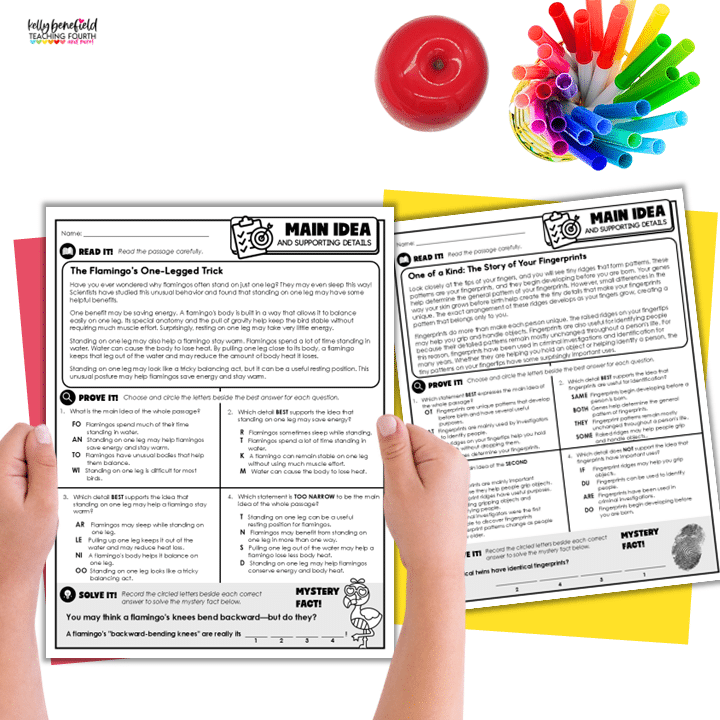
That’s why I created my Main Idea Read It. Prove It. Solve It. activities. Each activity begins with a short, high-interest passage followed by four questions that ask students to think about the main idea and supporting details. Their answers provide letters that they use to solve a final joke, fact, or mystery code.
The 20 passages are also divided into four levels of increasing difficulty. Students can begin with more straightforward main idea practice and then work toward passages and questions that require deeper thinking as their skills grow.
I especially like these activities for independent practice, morning work, reading centers, early finishers, small groups, review, or extra main idea practice. Students get the repetition they need, but the changing passages and final puzzles help keep that practice from feeling like more of the same.
[Take a closer look at the Main Idea Read It. Prove It. Solve It. activities.]
Frequently Asked Questions About Teaching Main Idea
What is the difference between topic and main idea?
The topic tells what a text is mostly about, while the main idea tells the most important thing the author wants the reader to understand about that topic.
For example, honeybees might be the topic of a passage, while Honeybees use special movements to communicate with other bees could be the main idea. Helping students ask, “What does the author want me to understand about this topic?” can make the difference much clearer.
How do you teach main idea and supporting details?
I like to teach main idea and supporting details as pieces that work together rather than as separate skills. Begin by helping students identify the topic. Next, determine what the author wants readers to understand about that topic. Then look at the important details and ask how they support or prove the main idea.
Model this process with short texts before asking students to work independently. Graphic organizers, highlighting important details, and thinking aloud can all help students see the connection between the main idea and its supporting details.
Why do students struggle with finding the main idea?
One of the biggest challenges is that students often confuse the topic with the main idea. Others may choose an interesting detail from the passage rather than thinking about the text as a whole.
Students can also have difficulty deciding which details are truly important. Teaching them to ask, “Does this detail help support the main idea?” gives them a simple way to evaluate the information they are reading.
How can I help students who struggle with main idea?
Start small. Use short passages with clear main ideas and model your thinking as you read. Identify the topic first, talk about the important details, and then put those ideas together to determine the main idea.
Once students are successful with clear examples, gradually increase the difficulty. You can introduce passages with less obvious main ideas, extra details, or multiple paragraphs. This allows students to practice the same reading skill while gradually becoming more independent.
What are some fun ways to practice main idea?
Main idea practice doesn’t always have to look like a traditional worksheet. Students can identify the main idea of a favorite nonfiction picture book, use highlighters to find supporting evidence, sort important and unimportant details, complete graphic organizers, work with a partner, or solve a puzzle after reading a short passage.
The important thing is to keep students thinking about the text. No matter what activity you choose, continue asking them to explain not only what the main idea is, but how they know.
Helping Students Become Confident With Main Idea
Teaching main idea takes time and plenty of practice. For many students, the biggest change comes when they stop thinking of main idea as something they simply have to find and begin thinking about how the ideas and details in a text work together.
Start with the topic, model your thinking, and help students identify the details that truly matter. Most importantly, keep asking students to prove their thinking with evidence from the text. With modeling, guided practice, and plenty of opportunities to work independently, students can become much more confident at identifying main idea and supporting details.
And remember, you don’t have to teach everything at once! Begin with short, manageable texts and gradually increase the challenge as your students are ready.
If you’re looking for another simple way to practice this skill, you may also enjoy my main idea activity using nonfiction picture books. It’s an easy way to give students additional main idea practice while using books you may already have in your classroom.
Looking for more ideas or tips for teaching main idea? Check out this post with a Simple and Easy Main Idea Activity.
You may also like:
10 Fun Reading Response Activities for Upper Elementary
Reading Comprehension Graphic Organizers